
Introduction: The Invisible Cost Every Bettor Pays
Most football bettors believe that odds simply reflect the probability of an event happening. If Team A has odds of 2.00, it feels natural to assume that the bookmaker thinks the team has a 50% chance to win.
That assumption is wrong.
Bookmakers do not offer “fair” odds. Every price you see already includes a built-in cost — the bookmaker margin, also known as the overround or vig. This margin is how bookmakers make money regardless of who wins the match.
Understanding how bookmakers build margin into odds is one of the most important steps any serious bettor can take. Without this knowledge, concepts like value betting, expected value (EV), and closing line value (CLV) make little sense.
In this article, we’ll break down bookmaker margin step by step, using clear examples, simple math, and real market logic — no myths, no guesswork.

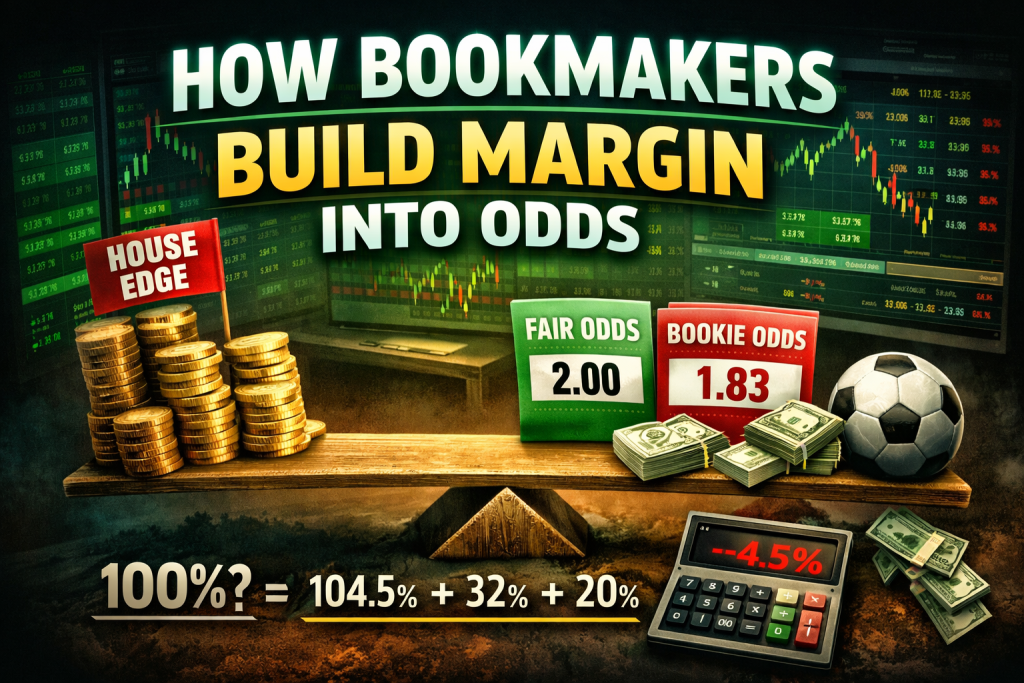
What Is Bookmaker Margin?
Bookmaker margin is the hidden percentage advantage the bookmaker builds into a market. It ensures that the total implied probability of all possible outcomes exceeds 100%.
In a perfectly fair market:
- The sum of probabilities = 100%
- The bookmaker would make no profit
In real betting markets:
- The sum of probabilities = more than 100%
- The extra percentage is the bookmaker’s margin
That extra percentage is the cost you pay for placing a bet.
Fair Odds vs Bookmaker Odds
Let’s start with a simple example.
Imagine a coin toss:
- Heads: 50%
- Tails: 50%
Fair odds would be:
- Heads: 2.00
- Tails: 2.00
Now look at how a bookmaker prices it:
- Heads: 1.91
- Tails: 1.91
Implied probability:
- 1 / 1.91 = 52.36%
- Total = 104.72%
That extra 4.72% is the bookmaker margin.
The event didn’t change — only the pricing did.
How Margin Is Calculated (Step by Step)
To calculate bookmaker margin, you simply:
- Convert odds to implied probabilities
- Add them together
- Subtract 100%
Example: 1X2 Football Market
Odds:
- Home win: 2.10
- Draw: 3.40
- Away win: 3.60
Implied probabilities:
- Home: 1 / 2.10 = 47.62%
- Draw: 1 / 3.40 = 29.41%
- Away: 1 / 3.60 = 27.78%
Total:
- 47.62 + 29.41 + 27.78 = 104.81%
Bookmaker margin:
- 4.81%
This means that even if you bet randomly across this market, the bookmaker expects to keep about 4.8% of all money wagered over time.
Why Bookmakers Always Win in the Long Run
Bookmakers don’t need to predict matches better than bettors. They only need to:
- Price odds with margin
- Balance risk across outcomes
- Adjust lines based on money flow
Because the margin is baked in, the average bettor is mathematically guaranteed to lose over time unless they consistently find odds that are mispriced relative to true probability.
This is why:
- Winning a few bets means nothing
- Long-term results matter more than short-term variance
Different Margins for Different Markets
Not all betting markets have the same margin.

Typical Margin Ranges:
- Top leagues (1X2): 3–5%
- Asian handicaps: 2–3%
- Totals (Over/Under): 3–5%
- Player props: 6–10%+
- Accumulators: extremely high (often hidden)
The more complex or recreational the market, the higher the margin.
This is also why professional bettors prefer:
- Asian markets
- High-liquidity leagues
- Sharp bookmakers
How Bookmakers Adjust Margin Without You Noticing
Bookmakers don’t advertise margin. Instead, they manipulate it subtly by:
- Shortening favorites more than outsiders
- Offering “boosted odds” while increasing margin elsewhere
- Adjusting less popular outcomes more aggressively
This creates the illusion of good value while preserving the house edge.
A common trick is favorite bias — popular teams are priced slightly shorter than they should be because bookmakers know most bettors prefer backing favorites.
Margin vs Probability: Why Odds Are Not Truth
Odds are not predictions.
They are prices designed to:
- Reflect market opinion
- Attract balanced money
- Guarantee profit via margin
This is why odds should never be interpreted as “what will happen.” They represent what the bookmaker wants you to pay for a position.
Understanding this distinction is critical for value betting.
How Value Bettors Beat the Margin
Value betting exists because:
- Bookmakers are not perfect
- Markets move
- Information is asymmetric
A value bet occurs when:
- Your estimated probability > bookmaker implied probability
Even with margin included, mispriced odds still happen, especially:
- Early lines
- Lower leagues
- Niche markets
- Injury or lineup news delays
Over time, beating the margin consistently is the only path to profitability.
Margin and Closing Line Value (CLV)
Professional bettors don’t focus on winning bets — they focus on beating the closing line.
If you consistently bet at odds that later move lower:
- You beat the market
- You beat the margin
- Profit follows long term
This is why CLV is a stronger indicator of skill than short-term ROI.
Why Accumulators Are Margin Multipliers
Each leg in an accumulator includes margin.
When you combine multiple legs:
- Margins compound
- True probability drops faster than odds suggest
This is why bookmakers aggressively promote accumulators — they are mathematically designed to extract more margin from bettors.
Key Takeaways
- Bookmaker margin is the hidden cost in every bet
- Odds always imply probabilities greater than 100%
- The margin guarantees bookmaker profit over time
- Different markets have different margins
- Beating the margin is the foundation of value betting
- CLV matters more than short-term wins
Once you understand how bookmakers build margin into odds, betting stops feeling like gambling — and starts looking like a pricing game.
If this topic interests you, our guides on Onboarding Bonuses vs Reload Bonuses: What’s the Real Difference and KYC and Account Verification at Bookmakers Explained cover closely related ground.
