
Introduction
Many sports bettors believe that winning bets is the ultimate measure of success. After all, betting seems simple on the surface: you place a bet, it either wins or loses, and the balance goes up or down.
Professional bettors, however, judge success very differently. Instead of focusing on short-term results, they track Closing Line Value (CLV) — one of the most important indicators of long-term betting skill.
CLV helps answer a far more meaningful question than “Did this bet win?”:
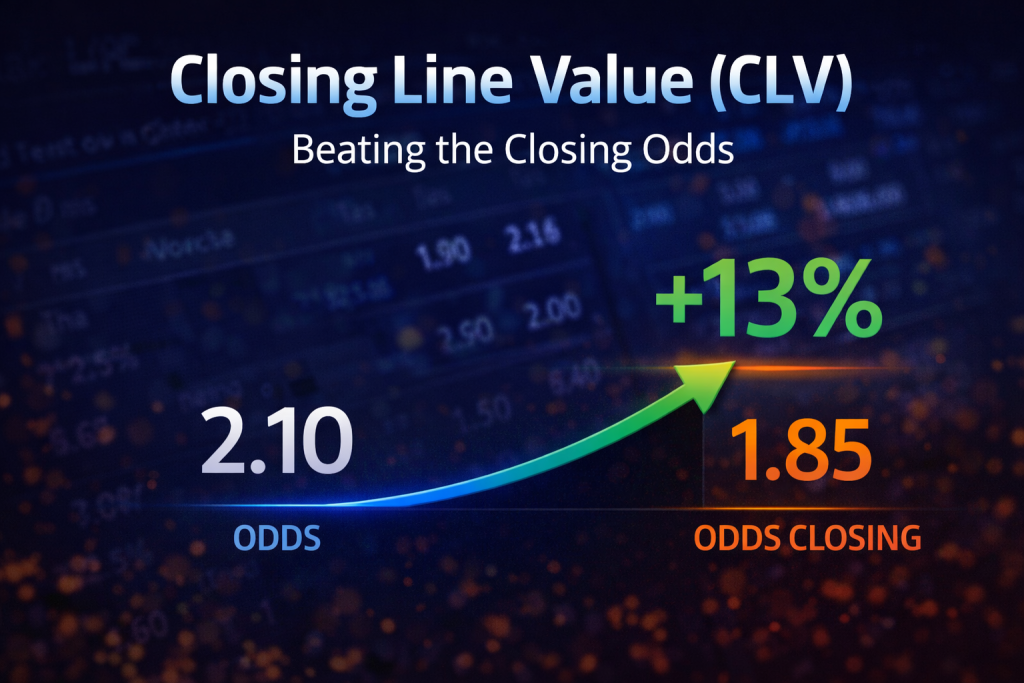
Was this bet good at the moment it was placed?
In this article, you will learn:
- What Closing Line Value (CLV) really means
- Why closing odds matter more than results
- How CLV works in football betting markets
- How professionals use CLV to measure edge
- Why losing bets can still be excellent decisions
What Is Closing Line Value (CLV)?
Closing Line Value (CLV) measures whether the odds you took were better or worse than the final odds offered by the bookmaker just before kickoff (or before the event starts).
In simple terms:
- If you place a bet at higher odds than the closing line → positive CLV
- If you place a bet at lower odds than the closing line → negative CLV
Simple Example
- Odds you bet: 2.20
- Closing odds: 2.00
You beat the market.
This is positive CLV, regardless of the final result of the match.
CLV does not care about winning or losing a single bet. It measures price quality, not outcomes.
Why Closing Odds Are So Important
Closing odds are widely considered the most accurate estimate of true probability available in betting markets.
Why?
- The largest volume of money enters the market close to kickoff
- Sharp bettors have already placed their bets
- Late team news, injuries, and lineups are priced in
- Bookmakers have adjusted lines multiple times
By the time the market closes, odds represent the collective wisdom of thousands of bets, including those from professional bettors.
This is why consistently beating the closing line is one of the strongest signs that a bettor has a real edge.
CLV vs Winning Bets: Understanding the Difference
One of the most common beginner mistakes is confusing results with decision quality.
Consider this scenario:
Bettor A
- Bets odds 2.25
- Closing odds move to 2.00
- Bet loses
Bettor B
- Bets odds 1.85
- Closing odds drift to 2.20
- Bet wins
From a professional perspective, Bettor A made the better bet.
Why?
- Bettor A beat the market
- Bettor B took a poor price and benefited from variance
Short-term results are noisy and unreliable. CLV strips away that noise and focuses on whether you are consistently finding value.
How CLV Relates to Expected Value (EV)
CLV and Expected Value are closely connected.
- Positive EV bets tend to generate positive CLV over time
- Negative EV bets usually show negative CLV
While EV requires estimating true probabilities, CLV provides a market-based validation of those estimates. If the market consistently moves in your favor, it suggests your assessment of probability was more accurate than the bookmaker’s initial line.
For this reason, many professional bettors use CLV as a practical proxy for EV, especially in complex markets like football.
How to Measure Closing Line Value in Practice
There are several common ways bettors track CLV:
1. Odds Comparison
The simplest method:
- Record the odds you bet
- Compare them with the final odds before kickoff
2. Percentage Difference
Some bettors calculate CLV as a percentage difference between bet odds and closing odds, allowing easier comparison across different markets.
3. Long-Term Tracking
Serious bettors track CLV across:
- Hundreds or thousands of bets
- Specific leagues
- Specific market types
Over time, CLV trends become very clear and reliable.
Why Bookmakers Care So Much About CLV
Bookmakers closely monitor which customers consistently beat closing lines.
- Bettors with positive CLV often face stake limits or account restrictions
- Bettors with consistently negative CLV are rarely limited
This behavior alone confirms how dangerous positive CLV bettors are to bookmakers. Random winners are harmless. Market beaters are not.
Common Misunderstandings About CLV
“CLV Doesn’t Matter If I’m Profitable”
Short-term profit can be driven by variance. CLV helps determine whether profits are sustainable.
“You Need Positive CLV on Every Bet”
No bettor beats the closing line every time. What matters is average CLV over a large sample size.
“Positive CLV Guarantees Profit”
CLV improves long-term expectation but does not eliminate variance. Proper bankroll management remains essential.
Final Thoughts
Closing Line Value is one of the most powerful tools a bettor can use to evaluate their performance objectively.
If you want to think like a professional:
- Stop judging bets by wins and losses
- Focus on whether you consistently beat the market
- Track CLV alongside profit and bankroll growth
In the long run, bettors who make good decisions consistently will outperform those who rely on luck.
Good prices beat good predictions.
How Much CLV Actually Predicts Long-Term Success
Closing line value has become a popular metric among serious bettors because, unlike win rate over a small sample, it correlates strongly with genuine long-term skill even when measured over a relatively modest number of bets. A bettor who consistently gets better odds than the closing price, meaning the market moved in their favour after they placed the bet, is demonstrating that their assessment was ahead of where the wider market eventually settled, which is a meaningful signal regardless of how any single bet actually resolved. This is why professional bettors and syndicates track CLV as closely as, and sometimes more closely than, straightforward profit and loss, since a positive CLV track record over a large enough sample is one of the most reliable indicators available that a betting approach has real predictive value rather than simply being on a lucky run.
Practical Ways to Track Your Own Closing Line Value
Measuring personal CLV does not require specialist software – a simple spreadsheet recording the odds taken at the time of the bet alongside the closing odds for that same selection, checked shortly before kickoff, is enough to start building a meaningful dataset. Consistency in when the closing price is recorded matters, since odds can still move in the final minutes before a match starts, so picking a standard point, such as five minutes before kickoff, and sticking to it across all tracked bets keeps the comparison fair. Reviewing this data every month or so, looking at the percentage of bets where the closing odds were shorter than the odds taken, gives a running picture of whether a betting approach is finding value ahead of the market or simply keeping pace with it. Bettors who see consistently negative CLV over a large sample, even if short-term results have been positive, should treat that as a signal to revisit their selection process, since it suggests the market is not agreeing with their read of value over time.
If this topic interests you, our guides on Multi-Bookmaker Accounts: Why Serious Bettors Use More Than One and Steam Moves and Reverse Line Movement Explained cover closely related ground.
