
The Popularity Trap of Accumulator Bets
Accumulator bets (also known as parlays) are one of the most popular bet types in football betting. Bookmakers aggressively promote them with boosted odds, flashy odds slips, and tempting potential payouts. Turning a small stake into a massive win feels exciting, logical, and “worth a shot.”
But here’s the uncomfortable truth: accumulator bets are mathematically designed to lose.
This is not opinion. It’s not bias. It’s not “bad luck.”
It’s pure probability and compounded bookmaker margin.
To understand why accumulators are so profitable for bookmakers — and so destructive for bettors — we need to break down the math behind them.
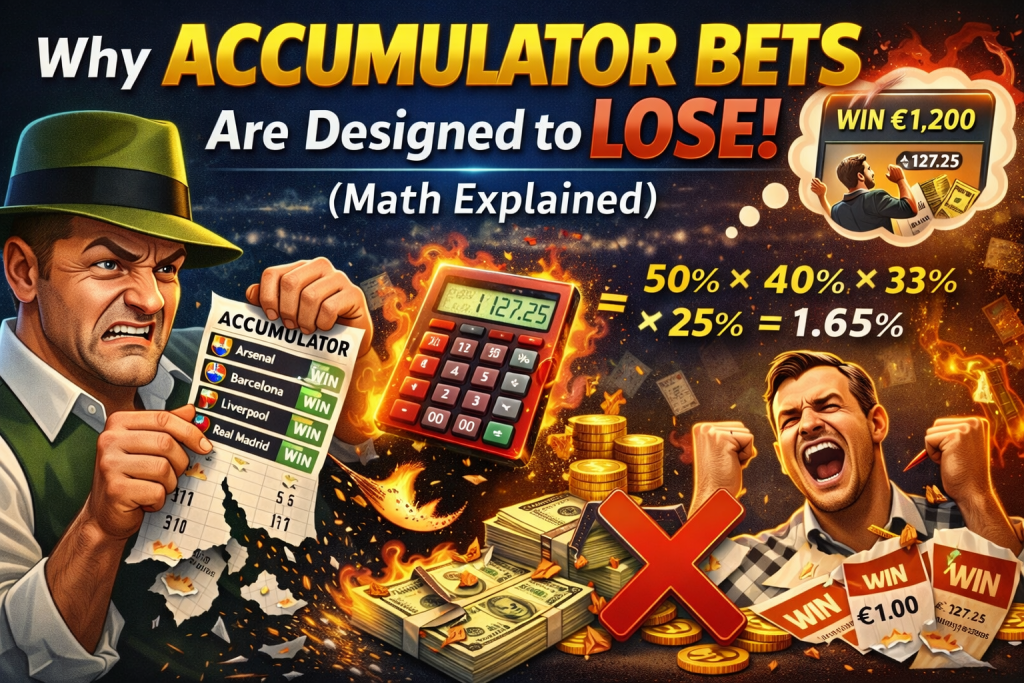
Single Bets vs Accumulators: A Critical Difference
With a single bet, you are fighting against:
- one probability
- one bookmaker margin (overround)
With an accumulator, you are fighting against:
- multiple probabilities
- multiple margins multiplied together
This distinction changes everything.
Bookmakers don’t need you to be wrong often.
They only need one leg to fail — and probability guarantees that it usually will.
The Mathematics Behind Accumulator Failure
Let’s start with a simple example.
Imagine placing four bets, each with:
- true probability: 50%
- fair odds: 2.00
If odds were fair, the accumulator odds would be:
2.00 × 2.00 × 2.00 × 2.00 = 16.00
Now calculate the real probability:
0.5 × 0.5 × 0.5 × 0.5 = 6.25%
Fair odds for a 6.25% chance:
1 / 0.0625 = 16.00
So far, so good.
Now enter the bookmaker margin.
How Bookmaker Margin Explodes in Accumulators
Bookmakers do not offer fair odds.
They reduce odds slightly on every selection.
Instead of 2.00, each leg might be priced at 1.91.
Single bet margin feels small.
But accumulators multiply that margin brutally.
New accumulator odds:
1.91 × 1.91 × 1.91 × 1.91 ≈ 13.30
Real probability remains:
6.25%
But fair odds should still be:
16.00
That gap — 13.30 vs 16.00 — is pure bookmaker profit.
And this gap grows exponentially with every added leg.
Why More Legs = Worse Expected Value
The Compounding Probability Problem Most Bettors Ignore
One of the biggest misunderstandings in accumulator betting is how brutally compound probability works against the bettor.
Many people intuitively think:
“If each bet has a good chance, surely the accumulator does too.”
But probability does not add up — it multiplies.
Even high-probability selections collapse when combined.
Example:
- 5 selections
- each with a 70% chance of winning
Real probability:
0.70 × 0.70 × 0.70 × 0.70 × 0.70 = 16.8%
That means more than 83% of the time, the accumulator fails.
And that’s before bookmaker margin is even considered.
This explains why accumulators feel so frustrating:
they often lose by one leg, which is not bad luck — it is statistical inevitability.
Near Misses Are Not Bad Luck — They Are Structural
If you’ve ever thought:
“I only missed one match again…”
You’re experiencing a designed outcome, not randomness.
Bookmakers love near misses because:
- they keep bettors emotionally engaged
- they reinforce the illusion of being “close”
- they encourage repeat accumulator betting
From a statistical perspective, most losing accumulators will fail by exactly one selection.
That is how probability clusters outcomes.
This psychological effect is extremely powerful — and very profitable.
Variance Makes Accumulators Look Tempting (But Deadly)
Accumulators massively increase variance.
You will experience:
- long losing streaks
- rare but memorable wins
- distorted perception of skill
A single big win can emotionally override:
- dozens of mathematically losing bets
- months of negative expected value
This is why many recreational bettors believe:
“Accumulators work for me.”
In reality, variance is hiding the damage until it’s too late.
Why Professionals Avoid Accumulators Completely
Professional bettors think in:
- thousands of bets
- long-term EV
- risk control
Accumulators destroy all three.
They:
- make bankroll swings uncontrollable
- hide true performance
- magnify bookmaker edge
That’s why professional betting accounts:
- almost never place parlays
- focus on isolated value
- accept small, boring edges
Profitability in betting is boring by design.
Can Accumulators Ever Make Sense?
There are very rare edge cases:
- correlated selections priced incorrectly
- promotional mistakes
- niche markets with weak modeling
But for 99.9% of bettors, these situations are:
- hard to identify
- impossible to repeat
- quickly limited by bookmakers
For the average bettor, accumulators are entertainment products, not financial tools.
The Honest Way to Use Accumulators (If You Still Want To)
If you enjoy accumulators:
- stake tiny amounts
- separate them from your main bankroll
- treat them like lottery tickets
Never confuse:
- excitement with edge
- big payouts with good bets
- occasional wins with profitability
Math always wins in the long run.
Final Verdict: Math Doesn’t Care About Hope
Accumulator bets survive because:
- they feel logical
- they feel exciting
- they sell dreams
But mathematics is ruthless.
Every extra leg:
- lowers true probability
- increases bookmaker edge
- moves you further from long-term profit
If your goal is education, control, and sustainability, accumulators are the wrong weapon.
This is where most bettors make a fatal mistake.
They believe:
“If each bet is good, the accumulator must be good too.”Math says the opposite.
Every additional leg:
increases variance

multiplies margin

destroys expected value (EV)
Even if you somehow find slight value on one selection, combining it with others almost always turns the overall bet into negative EV.
This is why professional bettors almost never place accumulators.
The Psychological Weapon: Big Wins, Small Probabilities
Bookmakers understand human psychology perfectly.
Accumulators exploit:
overconfidence

entertainment bias

lottery thinking

emotional betting
A €5 stake to win €500 feels irresistible.
But expected value doesn’t care about feelings.
A bet that wins once in 100 tries but loses money on average is still a bad bet — no matter how exciting the payout looks.
Why Bookmakers Love Accumulators
From a bookmaker’s perspective, accumulators are perfect.
They:
- increase margin without raising suspicion
- reduce risk (many ways to win)
- smooth profits across huge volumes
- encourage recreational betting behavior
This is why bookmakers:
- push accumulators on the homepage
- offer “acca boosts”
- promote “bet builders”
If accumulators were dangerous to bookmakers, they wouldn’t advertise them so aggressively.
Accumulator Boosts: A Clever Illusion
“But what about accumulator boosts?”
Boosts look generous.
In reality, they rarely fix the core mathematical problem.
A 10% boost on terrible odds is still terrible odds.
Boosts:
- slightly reduce losses
- never turn negative EV into positive EV consistently
- exist to increase volume, not fairness
The Professional Alternative: Single Bets and Value
Sharp bettors focus on:
- single bets
- accurate probabilities
- long-term expected value
They understand that betting is not about excitement — it’s about decision quality over thousands of bets.
If you want sustainable results, learning value betting and bankroll management matters infinitely more than chasing accumulator jackpots.
Final Truth: Accumulators Are Entertainment, Not Strategy
Accumulator bets are not “bad” in a moral sense.
They are:
- fun
- exciting
- emotionally rewarding
But accumulator bets are mathematically hostile to long-term profit.
If you treat accumulator bets as entertainment and price that entertainment accordingly, fine.
If you treat them as a serious betting strategy — the math will destroy you.
For related reading, see our guides on Why Odds Are Not True Probabilities (Bookmaker Math Explained) and Corner Betting Markets Explained.
