
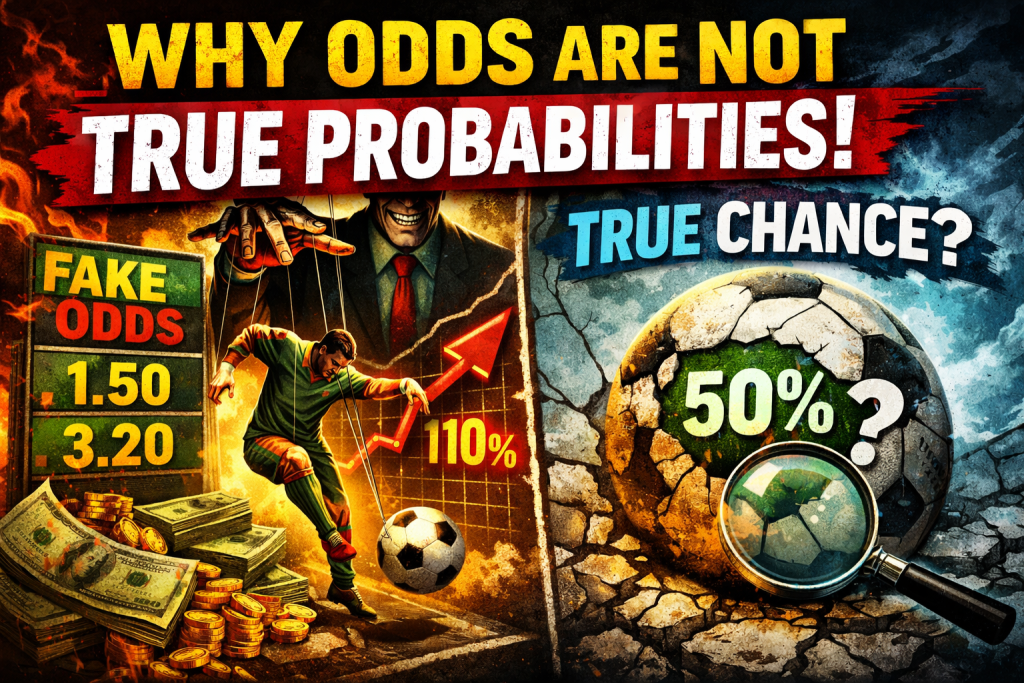
Odds are not true probabilities, even though most bettors treat them that way. Most bettors believe that betting odds directly represent the true probability of an event. Betting odds do not represent real probabilities. If a team is priced at odds of 2.00, many assume this means a 50 % chance of winning. This assumption feels logical, intuitive, and mathematically clean. Unfortunately, it is also completely wrong.
In reality, betting odds are not probabilities. They are prices—strategically engineered by bookmakers to protect margin, balance exposure, and exploit bettor behavior. Understanding this single concept separates casual bettors from those who think in terms of value, expected value (EV), and long-term profitability.
If you treat odds as probabilities, you will almost certainly lose in the long run. This article explains why odds are distorted, how bookmakers manipulate implied probabilities, and how smart bettors learn to think beyond the number shown on the screen.
The Biggest Misunderstanding in Football Betting, Restated
It’s worth restating plainly: the biggest misunderstanding in football betting is treating the odds themselves as an honest probability rather than a price shaped by margin and risk. Once you internalize that the biggest misunderstanding in football betting comes down to this price-versus-probability gap, the rest of this framework becomes far easier to apply consistently. For a deeper technical grounding, see this explanation of implied probability.
Why Odds Are Not True Probabilities
Let’s start with the basic formula most bettors know:
Implied Probability = 1 / Odds
So odds of 2.00 imply a probability of 50 %. Odds of 1.50 imply 66.67 %. On paper, this looks straightforward. The problem is that bookmakers never offer fair odds.
If odds truly reflected probabilities, bookmakers would operate at zero margin and rely purely on luck. That does not happen. Every market contains a built-in edge called overround (also known as margin or vig).
This means the sum of implied probabilities across all outcomes is always greater than 100 %.
The Overround: Where Probability Gets Corrupted
Consider a simple football match:
- Home win: 2.10
- Draw: 3.40
- Away win: 3.60
Implied probabilities:
- Home: 47.62 %
- Draw: 29.41 %
- Away: 27.78 %
Total: 104.81 %
That extra 4.81 % is the bookmaker’s margin. Already, probabilities are distorted before a single bet is placed.
This alone proves a crucial point:
👉 Odds cannot represent true probabilities because probabilities cannot exceed 100 %.
Why Bookmakers Don’t Want True Probabilities
Bookmakers are not prediction companies. They are risk management businesses. Their goal is not to predict outcomes accurately—it is to:
- Guarantee profit through margin
- Control exposure on each outcome
- Exploit bettor biases
- React to money flow, not truth
Odds are therefore market prices, not statistical truths.
This is why odds move even when no new information appears. The market reacts to where money is coming from, not to changes in real probability.
Public Bias and Probability Distortion
One of the biggest reasons odds drift away from true probability is public betting behavior.
Most recreational bettors:
- Overbet favorites
- Overbet popular teams
- Overbet recent winners
- Overbet big leagues and big names
Because of this, bookmakers intentionally shorten odds on teams they expect the public to back heavily.
Example:
A true probability might justify odds of 1.90.
But public demand pushes the price down to 1.75.
Has the team become more likely to win?
No. The price simply reflects market pressure, not reality.
This is one of the key reasons value bettors often find better opportunities on:
- Underdogs
- Unpopular teams
- Boring leagues
- Late or sharp-driven markets
Odds Reflect Risk, Not Truth
Another misconception is that bookmakers set odds based on “what will happen.” In reality, they set odds based on how risky each outcome is to them. This is another reason odds are not true probabilities.
If too much money lands on one side:
- Odds are shortened to discourage more bets
- Other outcomes are boosted to attract money
This balancing act further disconnects odds from probability.
At this stage, odds represent:
- Exposure
- Liability
- Market sentiment
Not probability.
Why Closing Odds Are Still Not Perfect Probabilities
Sharp bettors often look at closing odds as the most accurate estimate of probability. This is partially true—but still imperfect.
Closing lines are:
- More efficient
- Less biased
- Heavily influenced by sharp money
However, they still include:
- Margin
- Market manipulation
- Structural inefficiencies
Even the sharpest markets are prices with friction, not clean probability models.
This is why professional bettors compare their own probability estimate to the market price, instead of trusting odds blindly. Because odds are not true probabilities, this comparison is the only reliable way to find value.
The Professional Approach: Price vs Probability
Winning bettors flip the thinking process:
❌ “The odds are 2.20, so the chance is about 45 %.”
✅ “I believe the true probability is 55 %. Are the odds high enough?”
This difference is everything.
If your estimated probability is higher than the implied probability after margin, you may have a value bet.
This is the foundation of:
- Value betting
- Expected value (EV)
- Long-term profitability
Without this mindset shift, betting becomes guessing.
Why Casual Bettors Never Notice This
Most bettors:
- Bet small samples
- Focus on short-term results
- Judge bets by wins and losses
Because of variance, it’s entirely possible to win for weeks while making negative-EV bets. This creates the illusion that odds “make sense.”
But over hundreds or thousands of bets, the mathematical edge always wins.
That edge exists precisely because odds are not probabilities.
Final Thoughts: Stop Trusting the Number
If you remember only one thing from this article, let it be this: Odds are not true probabilities:
Odds are a price set by a bookmaker—not a statement of truth.
They include margin.
They reflect market behavior.
They are shaped by public bias.
They are adjusted for risk, not accuracy.
The moment you stop asking “What will happen?” and start asking “Is this price wrong?”, you begin thinking like a profitable bettor.
For related reading, see our guides on Onboarding Bonuses vs Reload Bonuses: What’s the Real Difference and KYC and Account Verification at Bookmakers Explained.
