
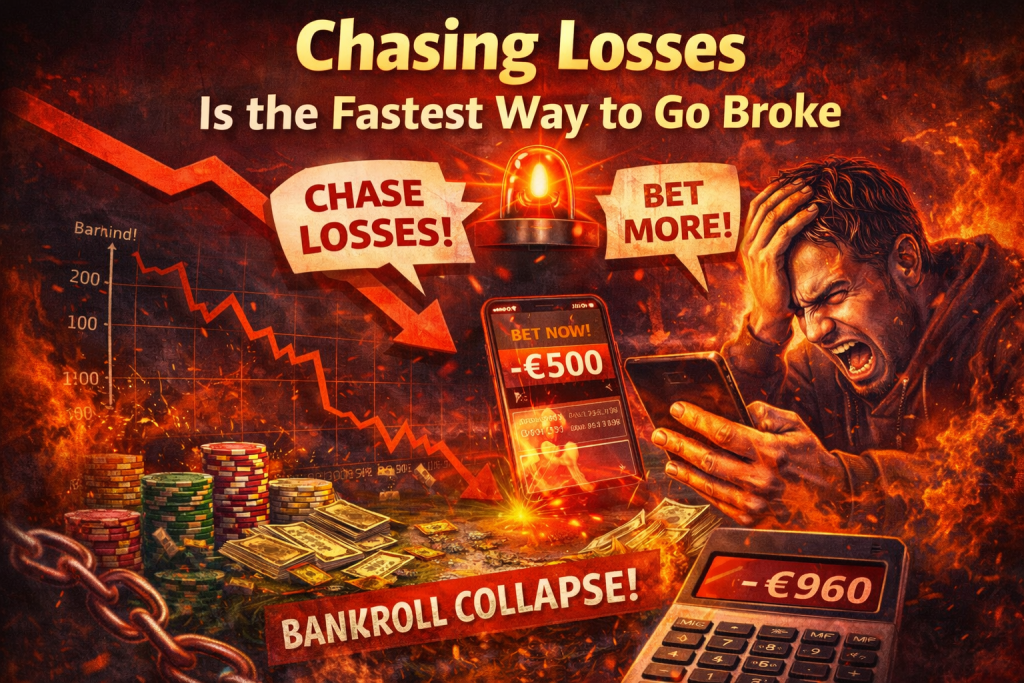
Chasing losses betting is one of the fastest ways to destroy a bankroll in football betting.
Chasing losses is one of the most destructive behaviors in football betting. Almost every bettor has done it at some point, often without realizing the long-term damage it causes. What starts as a simple attempt to “get back to even” frequently ends with a wiped-out bankroll.
Professional bettors do not chase losses. Not because they never feel frustration, but because they understand that chasing losses is mathematically and psychologically unsustainable.
This article explains what chasing losses really means, why it feels tempting, and why it is the fastest way to go broke in betting.
What Does “Chasing Losses” Actually Mean?
Chasing losses occurs when a bettor:
- increases stake size after a loss
- bets more frequently to recover quickly
- abandons bankroll rules temporarily
- takes lower-quality bets out of frustration
The goal is not to make a good decision, but to erase emotional discomfort caused by losing.
This mindset replaces logic with urgency — and urgency is the enemy of discipline.
Why Losing Feels So Uncomfortable
Losses trigger strong emotional reactions because they activate the same psychological mechanisms as financial stress.
Common reactions include:
- anxiety
- frustration
- anger
- fear of falling behind
Instead of accepting losses as part of variance, bettors try to eliminate discomfort immediately. Chasing losses becomes a coping mechanism, not a strategy.
Behavioral finance studies show that people feel losses more intensely than gains, a phenomenon known as loss aversion.
External reference: https://en.wikipedia.org/wiki/Loss_aversion
The Illusion of Control
Chasing losses creates the illusion that you can “fix” bad outcomes by acting decisively.
Bettors tell themselves:
- “I just need one good bet.”
- “This one is safer.”
- “I’ll lower risk after I recover.”
In reality, markets do not care about urgency. Odds do not improve because you feel pressured. Betting decisions made under stress are almost always worse. Many bettors fall into chasing losses betting because they believe one win will fix everything.
How Chasing Losses Destroys Bankrolls
Chasing losses damages bankrolls in multiple ways:
- Stake inflation
Larger stakes increase volatility and accelerate drawdowns. - Lower bet quality
Decisions are rushed and poorly analyzed. - Rule-breaking becomes normal
Once rules are broken once, breaking them again becomes easier. - Compounding mistakes
Each emotional decision increases the probability of another.
Together, these effects turn normal variance into irreversible damage.
Chasing Losses vs Variance
Many bettors confuse variance with failure.
Variance:
- is random
- is unavoidable
- affects all bettors
Chasing losses is an attempt to eliminate variance. This is impossible.
According to probability theory, short-term outcomes are dominated by randomness, regardless of edge.
External reference: https://en.wikipedia.org/wiki/Variance
Trying to outpace variance with aggression only increases risk.
Why Chasing Losses Often “Works” Once
One of the most dangerous aspects of chasing losses is that it sometimes works temporarily.
A bettor may:
- increase stake
- win one bet
- recover losses
This reinforces the behavior. The brain remembers the relief, not the risk. Over time, this conditioning leads to larger and more frequent chasing episodes.
Eventually, the inevitable losing streak arrives — and the bankroll collapses.
Why Chasing Losses Betting Destroys Bankrolls
Professional bettors understand that:
- each bet is independent
- losses do not require immediate correction
- discipline matters more than short-term results
They treat betting as a long series of decisions, not a single emotional battle.
When professionals lose, they do not increase stakes. They reduce exposure or pause if decision quality drops.
The Role of Bankroll Rules
Bankroll rules exist specifically to prevent chasing behavior.
Effective rules include:
- fixed unit size
- maximum stake limits
- predefined stop-loss rules
- daily or weekly betting limits
These rules remove decision-making during emotional states.
How to Break the Chasing Habit
Breaking the chasing habit requires structural changes, not willpower.
Practical steps:
- define unit-based staking
- automate stake sizing
- stop betting after predefined limits
- review bets only after cooling down
Discipline is easier when systems replace emotions.
Why Accepting Losses Is a Skill
Accepting losses is not weakness. It is a professional skill.
Losses:
- confirm variance exists
- test emotional control
- force long-term thinking
Bettors who accept losses calmly survive longer and make better decisions over time.
Long-Term Consequences of Chasing Losses
Chasing losses does not just destroy bankrolls. It damages:
- confidence
- discipline
- decision-making ability
Over time, betting becomes stressful instead of analytical. At that point, profitability becomes almost impossible.
Final Thoughts
Chasing losses feels like action, but it is actually panic disguised as strategy.
Every bettor faces losses. The difference between those who survive and those who go broke is simple:
- one group accepts losses
- the other tries to erase them immediately
Understanding why chasing losses betting is dangerous helps bettors protect their bankroll long term. In football betting, the fastest way to go broke is not bad picks — it is bad reactions.
How Chasing Losses Escalates So Quickly
The mathematics of loss chasing explains why it drains a bankroll faster than most bettors expect. If a bettor loses a 20 unit bet and then doubles the next stake to 40 units to try to recover the loss, a second loss now means chasing 60 units just to break even from the original loss, and this pattern compounds rapidly if the losing run continues even a few times further. Beyond the pure arithmetic, loss chasing typically also involves moving away from the careful selection process that produced reasoned bets in the first place, since the immediate goal shifts from finding value to simply recovering money as quickly as possible, which usually means accepting worse odds, more speculative markets, or larger stakes than normal research would ever justify. This combination of larger stakes and lower-quality selections is precisely why loss chasing is consistently identified as one of the fastest routes from a manageable losing stretch to serious financial damage.
Recognising the Warning Signs Before They Escalate
Several early signals tend to appear before loss chasing becomes a serious problem, and noticing them is the first step toward stopping the pattern. Increasing stake size specifically after a loss, rather than following a pre-planned staking approach regardless of recent results, is the clearest sign that emotion rather than strategy is driving decisions. Betting on markets or matches outside a normal area of research and confidence, purely because they are available right now and offer a chance to win back a loss quickly, is another common warning sign. A growing sense of urgency, betting sooner after a loss than usual rather than taking normal time to research the next selection, also tends to precede a chasing episode. Setting firm rules in advance, such as a maximum daily loss limit that triggers an automatic stop for the day regardless of how the next bet looks, removes the need to make a disciplined decision in the exact moment when emotional pressure makes that discipline hardest to maintain.
If this topic interests you, our guides on Each-Way Betting on Outright Markets: Top Scorer and League Winner Explained and European Handicap Betting Explained: How the 3-Way Market Works cover closely related ground.
