
Introduction: The Most Dangerous Assumption in Betting
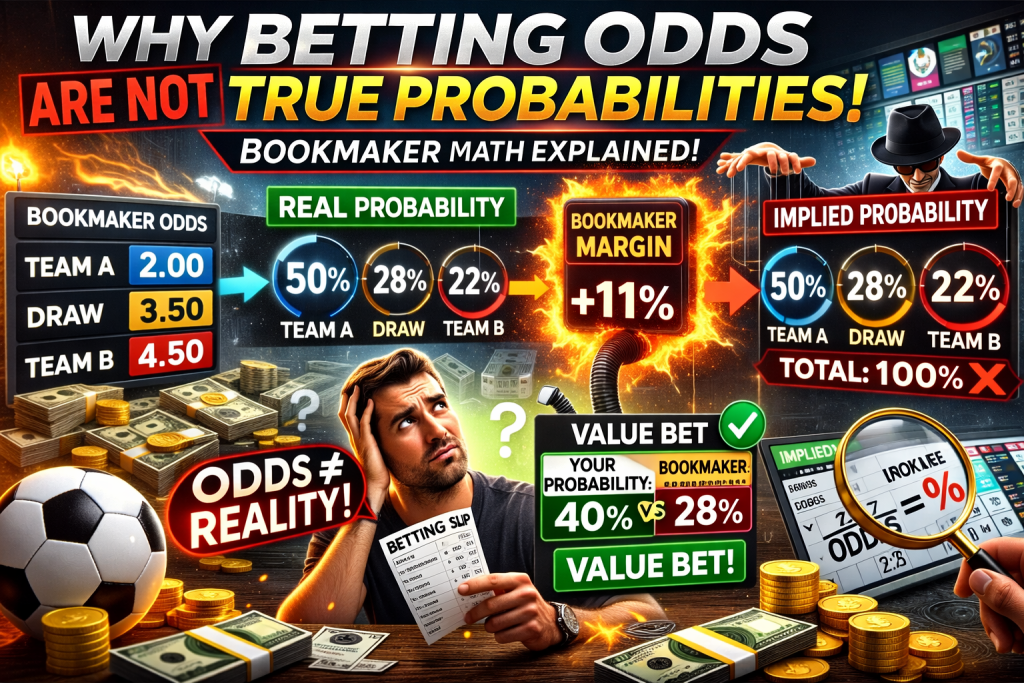
Bookmaker math is the reason betting odds never equal true probabilities. Betting odds probabilities are often misunderstood, because odds are not designed to represent true probabilities. One of the biggest mistakes bettors make — especially beginners — is assuming that betting odds represent true probabilities.

At first glance, this assumption feels logical. Odds look mathematical. They feel precise. They seem objective.
But betting odds are not probabilities.
They are prices, carefully engineered by bookmakers to guarantee profit, manage risk, and influence bettor behavior.
Understanding this difference is a critical step toward becoming a smarter bettor.
What Odds Are Supposed to Represent (In Theory)
In a perfect, fair world, odds would reflect true probability.
Example:
- A team has a 50% chance of winning
- Fair odds would be:
1 / 0.50 = 2.00
If all outcomes were priced this way, betting would be fair — and bookmakers would make no money.
But bookmakers are not charities. This is where bookmaker math takes over.
Implied Probability: The Illusion of Precision
Bookmakers convert odds into something called implied probability.This confusion around betting odds probabilities leads many bettors to trust prices that are mathematically distorted.
Formula:
Implied probability = 1 / odds
So odds of:
- 2.00 → 50%
- 1.50 → 66.67%
- 4.00 → 25%
Many bettors stop their thinking right here.
This is where the trap begins.

The Overround: Where Probabilities Break
Bookmakers build profit using overround — the total implied probability exceeding 100%.
Example (three-way football market):
| Outcome | Odds | Implied Probability |
|---|---|---|
| Home | 2.00 | 50% |
| Draw | 3.40 | 29.4% |
| Away | 3.80 | 26.3% |
Total:
105.7%
That extra 5.7% is bookmaker margin.
This means:
- odds are deliberately distorted
- probabilities are inflated
- prices are not fair
So even before kickoff, the bettor is already behind.
Why Odds Can Never Be True Probabilities
There are three core reasons odds are not real probabilities.
1️⃣ Bookmaker Math Prices Risk, Not Reality
Bookmakers do not ask:
“What is the true probability?”
They ask:
“How do we price this so we make money regardless of outcome?”
Odds are adjusted based on:
- betting volume
- liability
- market exposure
If too much money comes in on one side, odds will move — even if the real probability hasn’t changed.
This alone proves odds are not objective probabilities.
2️⃣ Public Bias Distorts Odds
Bookmakers know bettors are not rational.
They systematically overbet:
- favorites
- popular teams
- recent winners
To compensate, bookmakers:
- shorten odds on popular sides
- lengthen odds on unpopular sides
This creates biased pricing, not accurate probabilities.
Odds reflect bettor behavior, not truth.
3️⃣ Margin Is Added First, Accuracy Second
Bookmaker margin is non-negotiable.
Only after profit is secured do bookmakers worry about balance.
This means:
- probabilities are manipulated
- odds are skewed
- “true chance” is irrelevant
A Critical Example: Same Probability, Different Odds
Two teams may each have a realistic 50% chance of winning.
But bookmakers might price them differently because:
- one is more popular
- one attracts recreational bettors
- one creates liability risk
The odds change — the probability does not.
That alone destroys the idea that odds = probabilities.
Why This Misunderstanding Destroys Betting Strategies
If you believe odds are probabilities:
- you will misjudge value
- you will trust bad prices
- you will overestimate your edge
This leads to:
- poor expected value (EV)
- emotional betting
- long-term losses
Professional bettors never ask:
“What do the odds say?”
They ask:
“What is the real probability — and how wrong are the odds?”
Value Exists Only When Odds Are Wrong
Value betting exists precisely because odds are not probabilities.
Value happens when:
Your estimated probability > implied probability
If odds were accurate probabilities:
- value would not exist
- betting would be unbeatable
- bookmakers would fail
The entire betting ecosystem relies on mispriced probabilities.
Why Closing Line Value (CLV) Matters More Than Odds
Sharp bettors track Closing Line Value (CLV) — how their odds compare to the final market price.
If odds were true probabilities:
- early odds would not move
- CLV would be irrelevant
But odds move constantly.
Because they are prices, not truths.
The Psychological Comfort of False Certainty
Odds look clean.
Probabilities feel scientific.
This creates a dangerous illusion:
“The odds must know something.”
They don’t.
Odds know money, not truth.
Final Reality Check
Betting odds:
- are not predictions
- are not probabilities
- are not objective
They are commercial tools.
If you treat them as probabilities, you will lose.
If you treat them as prices — and learn when those prices are wrong — you finally start thinking like a professional.
Calculating the Overround Behind Any Set of Odds
Converting a full set of match odds into implied probabilities and adding them together reveals exactly how much margin a bookmaker has built into a market. For a three-way match result market with odds of 2.10, 3.40, and 3.60 on home win, draw, and away win, converting each to implied probability (dividing 1 by the decimal odds) gives roughly 47.6 percent, 29.4 percent, and 27.8 percent, which sum to about 104.8 percent rather than the 100 percent that true, fair probabilities would total. That extra 4.8 percent is the bookmaker’s overround, representing the built-in edge across the entire market regardless of which outcome occurs. Markets with tighter overround, closer to 102-103 percent, are generally found at operators competing hard on price or at sharp-focused bookmakers, while markets with overround above 106-107 percent, more common in niche props or lower-liquidity leagues, represent a noticeably higher hurdle that a bettor’s edge needs to clear before becoming profitable.
Why This Matters More Than the Headline Odds
Understanding overround changes how a bettor should interpret odds that look attractive at first glance. Two bookmakers might both offer odds on the same match, but if one has a tighter overround than the other, every single outcome across their market represents better underlying value even before considering which specific selection is being bet on – this is part of why serious bettors often gravitate toward a small number of operators known for consistently lower margins rather than treating all bookmakers as interchangeable. Comparing overround across the exact same market at different operators, rather than just comparing the price on one specific selection, gives a fuller picture of which bookmaker is offering better value across the board. Over hundreds of bets, consistently betting with lower-overround operators has a measurable compounding effect on long-run returns, in much the same way that basic odds shopping does, since both are ultimately about minimising the structural disadvantage built into every bet before a bettor’s own selection skill even comes into play.
For related reading, see our guides on Why Accumulator Bets Are Designed to Lose (Math Explained) and Onboarding Bonuses vs Reload Bonuses: What’s the Real Difference.
